7 Tools, 0 Customers: Why Solopreneurs Face $0 Months in 2026
Imagine pouring your heart into a business idea, tweaking your website late into the night, only to stare at a bank account that reads zero. Last year, 48% of solo business owners experienced at least one $0 revenue month. Worse, 72% considered quitting due to inconsistent income. These aren't fluke failures of bad ideas—they're symptoms of broken systems. For solopreneurs starting online businesses with limited technical skills, the real enemy isn't the market. It's the chaos of juggling everything alone. In 2026, AI Clear Benefits reveals how solopreneur statistics 2026 point to a clear path: automation that connects the dots without the overwhelm.
The $0 Month Problem — Why Inconsistent Revenue Is the #1 Killer for New Businesses
That empty revenue line isn't just disheartening—it's deadly. 51% of solopreneurs cite uneven cash flow as their biggest stressor, edging out even customer acquisition. Dig deeper into why most new businesses fail in the first year, and you'll find it's rarely product-market fit. It's cash flow chaos: leads that vanish, invoices unpaid, bookings missed. A recent survey showed 61% underestimated how hard it is to handle everything alone, turning ambitious launches into survival scrambles.
Picture this: You land a hot lead from social media, but your email follow-up gets buried in a overflowing inbox. No CRM to nurture it, no automation to remind them. Days turn to weeks, and poof—gone. Solopreneur challenges 2026 amplify this, with remote work blurring boundaries and economic pressures squeezing margins. Without steady income, burnout creeps in fast. The data doesn't lie: inconsistent revenue isn't a phase; it's the silent killer forcing 80% of solo ventures to fold before year two.
- 51%: Uneven cash flow tops stress lists.
- 61%: Solo operators blindsided by the workload.
- 80%: Businesses gone by year two, cash flow the culprit.
The Hidden Cost of Tool Sprawl
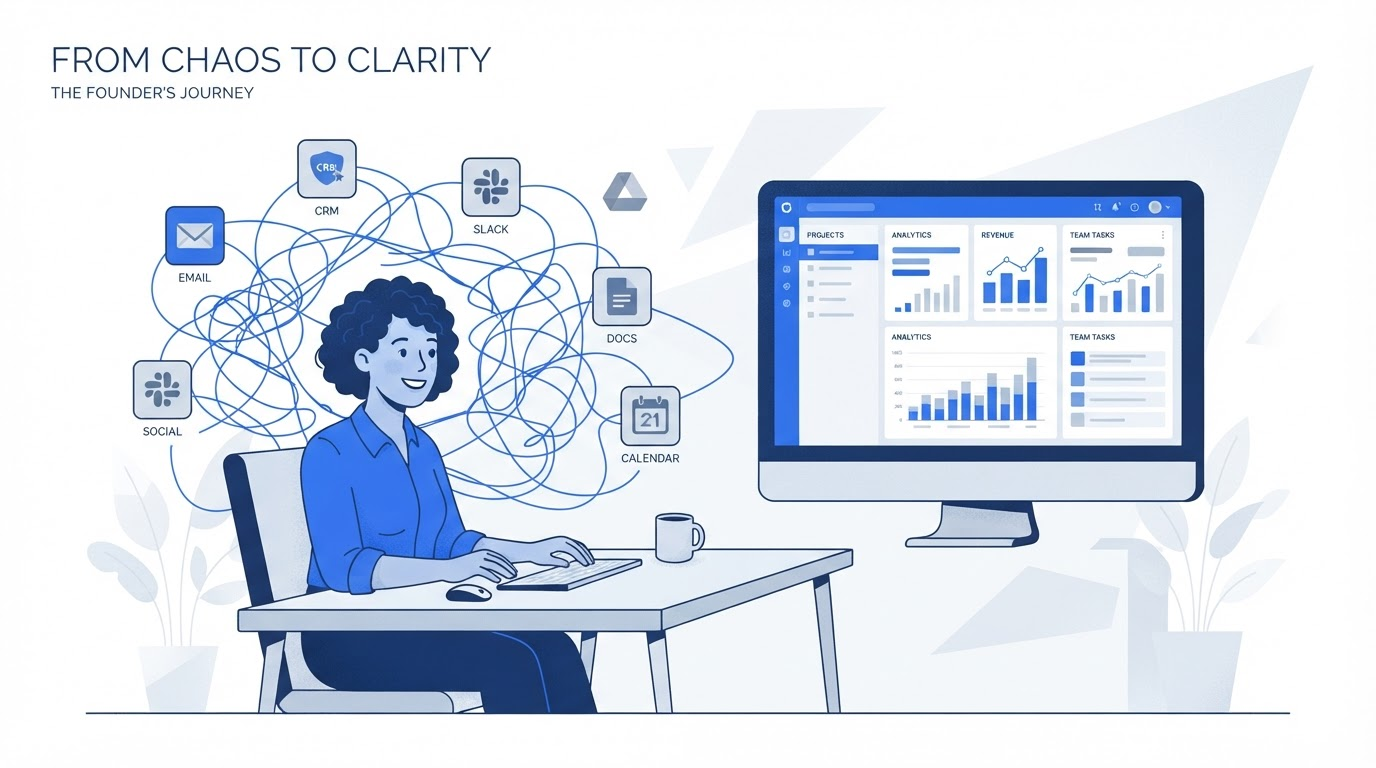
You start simple: a website builder here, email tool there, scheduler next. Before long, how many tools does the average small business use? Seven to nine, on average. That stack sounds efficient until reality hits. 46% of small business owners feel overwhelmed by their tech stack, wasting 6+ hours per week on app-switching and manual drudgery.
The cost of business software for startups adds up fast. Tally a basic setup—$50/month website, $29 email, $20 scheduling, $49 CRM, $25 invoicing, $49 marketing, $75 analytics—and you're at $297 per month. Yet customers? Still zero. Why? Lead leakage small business style: 40% of leads slip away without connected systems. One tool captures the inquiry; another handles follow-up—but nothing links them. You're firefighting instead of building.
Disconnected apps don't build businesses. They bury you in busywork.
This tool sprawl turns time management for solo founders into a nightmare. Hours vanish reconciling data across tabs, chasing forgotten tasks. No wonder revenue stalls.
The 3 Myths Keeping Solopreneurs Stuck
Myths persist like bad habits, trapping founders in $0 cycles. Bust them, and solopreneur challenges 2026 become opportunities.
Myth 1: "I Need More Tools"
Reality: Fewer, connected ones win. Adding apps fragments focus; integration multiplies results.
Myth 2: "I'll Set Up Systems Later"
Reality: 40% of leads leak now while you procrastinate. Systems from day one capture every opportunity.
Myth 3: "I Need to Be Technical"
Reality: Starting a business with no technical skills is standard—69% can't build a website from scratch, 40% lack tech know-how, yet thrive with no-code AI. Automation handles the heavy lifting, so you focus on what matters: customers.
These myths fuel the 7-tools, 0-customers trap. Shatter them, and momentum builds.
What the 52% Who Succeed Do Differently
Flip the script: the 52% dodging $0 months run lean, connected systems from launch. They reclaim time for revenue-generating work, sidestepping tool hell. Business owner burnout statistics are stark—75% report exhaustion from admin overload—but winners automate it away.
Time management for solo founders shifts: no more 6-hour app marathons. Instead, unified dashboards mean leads flow to bookings to payments seamlessly. Loss aversion hits hard here—every unsystematized month costs leads, momentum, sanity. Successful solopreneurs invest upfront in integration, harvesting compound gains: consistent follow-ups convert 3x better, repeat business soars.
- Lean stacks: One connected hub over sprawl.
- Day-one automation: No lead left behind.
- Customer focus: 80% more time on growth.
They treat systems as assets, not afterthoughts. Result? Steady revenue, no burnout.
The 47-Minute Launch
What if you could replace 7-tool chaos with one seamless system—website, booking, invoicing, AI follow-up—in under an hour? Enter the Cleaning Business Blueprint, a real-world example tested at AI Clear Benefits. I test the tools. You build the business.
This blueprint deploys on autopilot: AI crafts your site, sets up lead capture, automates nurturing to bookings, handles payments. No coding, no sprawl. It plugs the exact leaks—40% fewer lost leads, zero app-switching. For online service businesses, it's curated precision: what actually works, minus the hype.
Solopreneurs launch in 47 minutes, then watch systems hum. Revenue flows. $0 months fade. Clear benefits, proven.
Ready to End the $0 Months?
Don't let tool sprawl steal another lead. See what AI can build for your business at https://aiclearbenefits.com/business-os. Start connected, stay revenue-ready. Your first consistent month awaits.